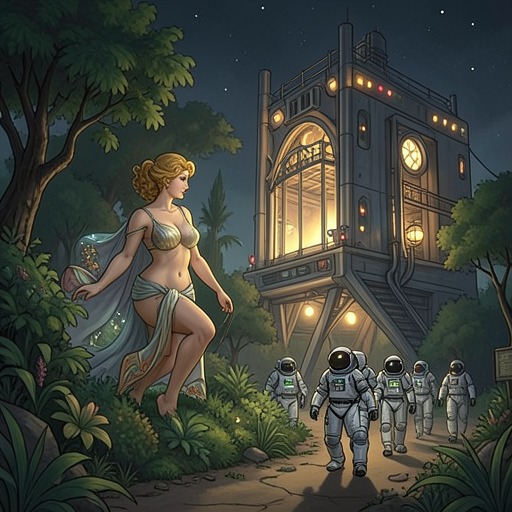
Lunar Orbital Anomaly and the Evacuation of Earth
Last and First MenThe Lunar Orbital Anomaly and the Evacuation of Earth transform the Fifth Men’s attention from the burden of the past to the survival of the species. An inexplicable change in the Moon’s orbit overturns trusted scientific expectations and presents a deadline on a scale that makes even ten million years urgent. The Fifth Men respond by making escape from Earth a social priority, building the technology for interplanetary travel, and eventually completing a centuries-long migration to Venus.
A Crisis in a Coherent Science
The discovery came while the Fifth Men were already oppressed by the tragic past. Their nearly perfect social order had even made suffering something to seek as a tonic, yet the past continued to poison their lives: lovers felt ashamed of their happiness, and guilt separated their spirits even when their bodies were united. The lunar anomaly redirected this melancholy. The present had become bewildering, and the future suddenly uncertain.
The crisis was not simply that the Moon was approaching. The Fifth Men possessed an unusually comprehensive and repeatedly tested system of natural science, and their understanding of the lunar orbit had a long history. The First Men had already learned that the Moon should first recede from Earth and, much later, return toward it. The Fifth Men had confirmed this account: in the remote future, the satellite would approach a critical distance, break into fragments, and form rings like those around Saturn. By their calculations, however, the Moon should have continued moving away for hundreds of millions of years. Instead, its recession had stopped and a comparatively rapid approach had begun.
Repeated observations and calculations did not disclose the cause. The Fifth Men proposed ingenious explanations, but none revealed the truth; the narrator says that a later, more brilliant species would discover a connection between a planet’s gravitation and its cultural development. For the Fifth Men, the discrepancy itself was destabilizing. In an age when knowledge was tightly integrated, a small conflict between fact and theory threatened intellectual vertigo across the entire system of science.
The Deadline and the Choice to Leave
The danger acquired its decisive force when the observed acceleration was projected forward. If it continued, the Moon would enter the critical zone and disintegrate in less than ten million years. Its fragments, unlike a stable ring, would soon fall upon Earth; the heat of their impact would make the planet’s surface uninhabitable for life. A short-lived species might have treated that interval as eternity. The Fifth Men thought in terms of the race and recognized that their social policy had to be governed by the coming catastrophe.
Some initially doubted that the Moon’s anomalous motion would persist. As the years passed, that reassurance became less plausible. People who had devoted much of their lives to exploring the past also attempted to explore the future, hoping to establish that human civilization would remain discoverable on Earth at any imaginable remove. Direct inspection failed. The Fifth Men wrongly surmised that future events, unlike past events, did not exist until the advancing present created them. Their inability to see the future did not remove the danger: the shrinking distance was observable, and humanity had to leave its native planet.
The alternatives were Mars and Venus. Mars had by then lost both water and atmosphere. Venus possessed a dense, moist atmosphere, but no oxygen; its surface was almost entirely shallow ocean, and its daytime heat would make survival difficult even at the poles. Venus was therefore not an immediately hospitable refuge but the more promising world on which the Fifth Men could attempt to establish a new home.
Building a Route Through Space
The Fifth Men took centuries to devise a tolerable means of interplanetary travel. Their immense rockets used the energy released by the annihilation of matter, propelling a vessel through the pressure of radiation. Because a minute quantity of matter yielded enormous energy, a ship could carry fuel for a voyage lasting months or years. Once it had left Earth’s atmosphere and reached full speed, it could continue without constant power from its rockets.
The first Ether ship embodied both the ambition and the scale of this engineering. Its cigar-shaped hull was about three thousand feet long, made of metals with artificial atoms far more rigid than previously known materials. Rocket apparatus positioned at different points let the ship advance, reverse, turn, or move sideways. Strong transparent windows allowed its passengers to look outward. Inside, it could accommodate a hundred people and provisions for three years. Air was to be manufactured during the voyage from pressurized protons and electrons; annihilation of matter supplied heat, while refrigeration could allow an approach as close to the Sun as Mercury’s orbit. An electromagnetic system provided adjustable artificial gravity to maintain a more normal human environment.
The first trial carried a navigating crew and a company of scientists toward the Moon. Its plan was to approach the surface, perhaps circle at an altitude of ten thousand feet, and return without landing. For days, radio messages reported that the voyage was proceeding well. Then communication ceased. Telescopes had detected a flash on the ship’s course near the time of its last message, and observers surmised that a collision with a meteor had fused the vessel in the heat of impact. That explanation remained a surmise, not a recovered account from the lost crew.
Later trials showed that the first loss was not an isolated hazard. Some ships went out of control, with crews sending messages that they were heading into outer space or plunging toward the Sun until suffocation silenced them. Others returned, but their crews were haggard and distraught after confinement in bad air. One vessel that attempted to land on the Moon broke its back; air rushed out, killing its people, and the wreck was later visible from Earth as a new speck on a lunar sea. These losses made the transition to spaceflight a succession of perilous experiments rather than a clean technological victory.
The Exodus and Its Aftermath
Over time, accidents became rarer, and voyages through the void eventually became popular amusement. The change in their status marks how far the Fifth Men had travelled from the first trial: a domain associated with missing ships and dead crews became a setting for ordinary recreation. Yet the Moon’s approach continued, and the ability to travel between worlds served a larger purpose than leisure.
Meanwhile, the Fifth Men prepared Venus for settlement. They bred terrestrial plants for its conditions and spread them across islands and sea. Because dry land was scarce, specially designed marine plants formed immense floating continents of vegetation; habitable pylons rose on the less torrid islands, among greenery occupying nearly every available acre. Even with these adaptations, Venus could never support Earth’s enormous population. No more than a hundred million people were expected to live there tolerably, so the population had to fall to a hundredth of its former size. This planned reduction also meant that the new society would be mentally poorer: on Earth, each person had been enriched by participation in a far more intricate and diverse social environment.
Departure became unavoidable when the Moon grew so large that it periodically turned day into night and night into a ghastly day. Prodigious tides and distressing weather had already damaged both the amenities of Earth and the fabric of civilization. Humanity left reluctantly, and the evacuation took centuries rather than occurring in one decisive flight. By its completion, Venus had received the remaining human population, representatives of many other species, and the most precious cultural treasures of humanity. The episode thus binds planetary catastrophe to a profound civilizational transfer: escape preserves life and inheritance, but the limited capacity of the new world requires humanity to become smaller and less socially intricate.